Amol B

What each app is actually for
Bookly (Mindburst, since 2016) is built around the reading session. You press start, read, press stop, and it tells you pages an hour, how long the book will take at your pace, and your longest streak, in a graphic you can share. Goals are in hours, pages or books. It is gamified on purpose — achievements, reminders, ambient sounds — and the paywall sits across the collection: ten books free, unlimited on Pro.
Bookmory (Tony Soft, since 2020) is a reading journal that happens to have a timer. Its signature screen is a calendar with the cover of whatever you read each day; around it sit statistics by author, publisher, language, star rating and tag, text extraction from photos for quotes, and CSV or Excel import. Everything is stored on the device, which is why it works in a lift and why sync between devices is a paid feature.
StoryGraph (Nadia Odunayo, since 2019) is a reading tracker built around data about books and about you: how a book made you feel and how fast it moved, half and quarter stars, re-reads and DNF, crowd-sourced content warnings, and charts of your year by mood, pace, genre and page count. It is web-first, independent, ad-free, and has a light social layer — profiles, buddy reads, and since September 2026 the ability to keep individual books private.
Feature by feature
| Bookly | Bookmory | StoryGraph | |
|---|---|---|---|
| Free tier | 10 books; timer, goals, stats | Unlimited; timer, calendar, stats, limited OCR | Unlimited; tracking, tags, core stats, import |
| Ads on free | Yes, full-page | Yes | None |
| Paid (US) | $4.99/mo, $29.99/yr, $79.99 lifetime; 7-day trial | $3.49/mo, $30.99/yr | Plus $4.99/mo, $49.99/yr; 30-day trial |
| Platforms | iOS, Android, Apple Watch | iOS, Android | iOS, Android, web (web-first) |
| Session timer | Yes — its core | Yes, with Lock Screen controls | No |
| Daily streak / calendar | Streak in stats | Calendar of covers by day | Reading goals by books and pages; no day streak |
| Statistics | Session infographics, speed, time-to-finish | By author, publisher, language, tag | Best in category: mood, pace, genre, pages over time |
| Ratings | Whole and half stars | Stars | Half and quarter stars; re-read and DNF |
| Paper books | Shelf photo to add books in bulk | Quote capture from a photo (unlimited on Premium) | No capture |
| Sync | Account-based; device-transfer losses reported | Paid; iCloud backup free | Account-based, free |
| Import | Goodreads CSV | CSV / Excel | Goodreads CSV, cleanly |
| Social | Share graphics | None | Light: profiles, buddy reads, optional |
Where Bookly wins
The session. Nothing else makes a thirty-minute read feel like a workout logged: pages an hour, a projected finish date that updates as you go, a card to post. If you are motivated by numbers about effort rather than numbers about books, Bookly is the one. The lifetime price, $79.99, is also the only way in this trio to stop paying.
Where it loses: the free tier. Ten books is a fortnight for a steady reader, and the full-page ads land on the actions you do most. The most common one-star review — from paying users too — describes streaks and sessions gone after moving to a new phone. Export before you switch devices.
Where Bookmory wins
The journal, and the price. A calendar that fills with covers is the most satisfying reading record any of the three produces, and the statistics by author, publisher and language suit readers who think in bibliographies rather than moods. Quote capture from a photo makes it the only one of the three that is genuinely useful with a paper book open. It is the cheapest paid tier here, and 4.8 stars across 16,000 iOS ratings says the people who pay are happy.
Where it loses: the ads on the free tier, which its own reviews say can crash the app; a title search that misses exact matches; and sync behind the paywall, so a second device means paying.
Where StoryGraph wins
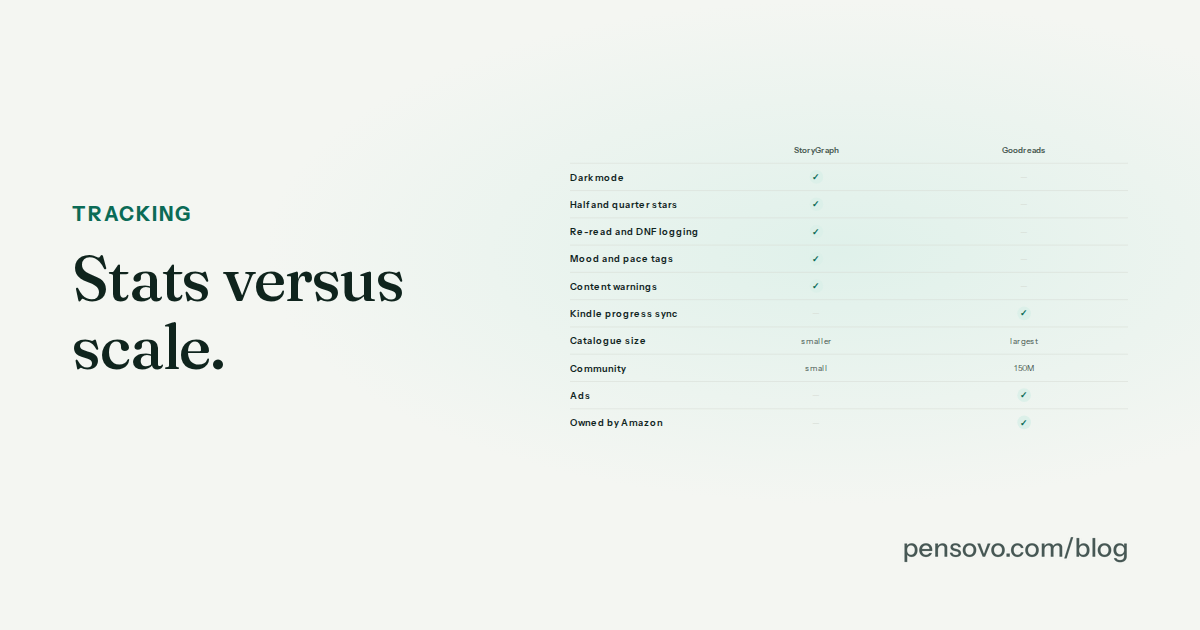
Everything about the books. If you want to know that your year skewed reflective and slow, that you abandoned four books in March, or that a novel carries a content warning before you start it, StoryGraph is alone in the category. It is also the only one of the three with no ads at any tier and the only one that is independent of both an ad network and Amazon. Import from Goodreads is the cleanest anywhere; our StoryGraph vs Goodreads comparison covers the switch.
Where it loses: it is not a habit tracker. There is no timer, no streak and no calendar of days — goals are in books and pages — and the mobile app is slower than the website. For a paper reader there is no page capture at all.
Which should you pick?
- You want to time every session and see your speed — Bookly, and pay for Pro or you will hit the cap.
- You want an offline journal with a calendar of covers and quotes from paper books — Bookmory.
- You want the best statistics, mood tags, half-stars and no ads — StoryGraph.
- You read on a Kindle — none of the three syncs with it; Goodreads does.
When none of the three fits
A fourth kind of reader turns up in every thread about these apps: someone who wants a free tracker with a daily streak, notes on paper books, no ads and no social layer, and does not want to pay to sync a second phone. None of the three is built for that — Bookly caps and shows ads, Bookmory shows ads and charges for sync, StoryGraph has no streak. That is the gap Pensovo, our app, is built for: unlimited books, a two-tap page log, a streak with a calendar and one save a month, photographing a page to keep the passage (on the phone, free, offline), Reading Mode with ambient sound, reviews with a shareable card, and free sync — with no ads. The paid layer is book summaries you can read or listen to, which is a separate product you can ignore. It is new, its summary catalogue is small, and it has no widget yet. Six private trackers compared puts it beside Book Tracker, Reading List and Leio as well.
Common questions
Is Bookly or Bookmory better?
Bookly for timing sessions and the graphics afterwards; Bookmory for a journal with a calendar of covers, quote capture and a cheaper, ad-free paid tier. Bookmory's free tier is unlimited with ads; Bookly's stops at ten books.
Is StoryGraph better than Bookly?
For statistics about your books — moods, pace, genres, half-stars, content warnings — yes, and StoryGraph has no ads or book cap. For timing a reading session and tracking a daily streak, Bookly does things StoryGraph does not do at all.
Does Bookly have a book limit?
Yes. The free version is limited to ten books and shows full-page ads. Bookly Pro removes both at $4.99 a month, $29.99 a year or $79.99 for life, after a seven-day trial.
Does Bookmory have ads?
Yes, on the free tier; Premium ($3.49 a month or $30.99 a year) removes them and also unlocks unlimited text extraction from photos and sync between devices.
Does StoryGraph have a reading timer or streak?
No. StoryGraph tracks books, pages and reading goals by count, with detailed statistics, but it has no session timer and no daily streak or calendar. Bookly and Bookmory both have timers; Pensovo has a streak and calendar.
Which of the three works best with paper books?
Bookmory, which captures quotes from a photo of the page. Bookly photographs a shelf to add books in bulk but not a page. StoryGraph has no capture. Pensovo and Book Tracker also capture passages from a page.
Which one is free with no ads?
Only StoryGraph, of the three. Pensovo, Hardcover and Goodreads' tracker are also free without ads on the tracking itself (Goodreads shows ads in its feed).