Amol B

How we compared them
Five questions, in this order, because they are the ones that decide whether an app survives a month of real use. What can you do without paying? Does the free tier carry ads or a book cap? Does it do the physical-book jobs — logging a page, photographing a passage, working offline? Is it on both platforms? And what does a year cost if you do pay? We did not score design taste, and we declare the bias up front: Pensovo is our app. Where it is weak we say so, in the same column as everyone else.
Prices are from the US App Store and Google Play in October 2026. Indian prices, where an app sets them by hand rather than converting dollars, are in the India comparison.
The eight, compared
| App | Platforms | Free tier | Ads | Paid (US) | Standout | Weak spot |
|---|---|---|---|---|---|---|
| Pensovo | iOS, Android | Unlimited books, two-tap page log, streaks and calendar, notes and page capture, collections, Reading Mode, reviews and share cards, sync | None | $5.99/mo, $49.99/yr (7-day trial on yearly) — summaries, narration, PDF summaries, extra streak saves | The free tier is the whole tracker; passages from a photo, on the phone | New (launched October 2026); summary catalogue still small; no widget; export still on the roadmap |
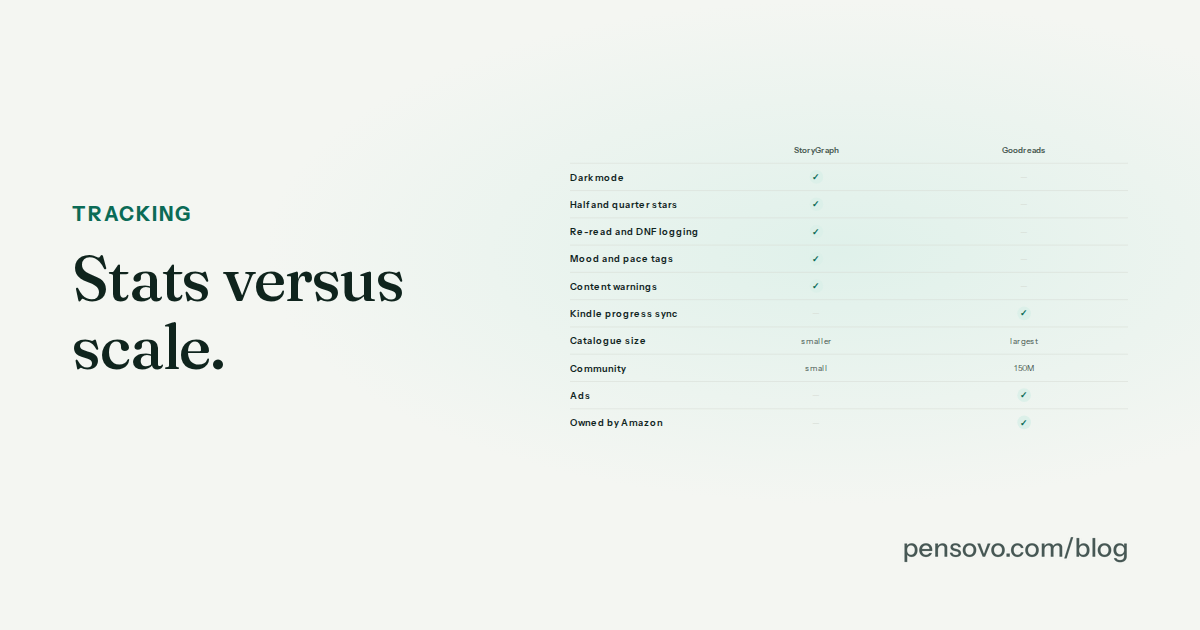
| StoryGraph | iOS, Android, web | Tracking, mood and pace tags, content warnings, core stats, import | None | Plus $4.99/mo, $49.99/yr | Best statistics in the category; independent; private books since September 2026 | App slower than the site; no daily streak or calendar; light social layer |
| Goodreads | iOS, Android, web | Everything | Yes | Free | Largest catalogue anywhere; 150M members; Kindle progress sync | No dark mode, whole stars only, no re-read or DNF, a feed you did not ask for |
| Bookmory | iOS, Android | Unlimited, offline-first, timer, calendar of covers, limited OCR | Yes | $3.49/mo, $30.99/yr — removes ads, unlimited OCR, device sync | Offline journal with a loyal base (4.8★, 16k ratings on iOS) | Ads on the free tier, which reviews say can crash it; weak title search; sync is paid |
| Bookly | iOS, Android, Watch | 10 books, timer, goals, stats | Full-page | $4.99/mo, $29.99/yr, $79.99 lifetime | The best reading timer and the infographics after a session; shelf-photo bulk add | Ten-book cap; the most common one-star review is sessions lost after changing phones |
| Margins | iOS; Android beta since Sept 2026 | Most tracking | None | $5.99/mo, $59.99/yr | Beautiful; "vibes" search; focus timer; illustrated monthly recaps | Priciest subscription; missing books take months to appear; no page capture |
| Book Tracker | iPhone, iPad, Mac, Watch | 5 books | None | $19.99 once | Pay once, own it; passage capture; no account needed | Apple only; five-book cap until you pay |
| Hardcover | iOS, Android, web | Tracking, lists, stats | None | Supporter $4.99/mo | Open API, public roadmap, community-led | Android app is a web wrapper with crash reports; no streak |
Two apps clear all four of the cheap questions — free without a cap, no ads, on Android, and able to photograph a page: Pensovo and, if you count paid OCR as a yes, Bookmory. That is the shape of the market in one line: the fully free trackers are new or ad-funded, the polished ones charge $50–60 a year, and the oldest one is free because it sells books.
1. Pensovo — best free tracker for paper-book readers
Everything about your own reading is free: unlimited books (including ones no catalogue has heard of — type the title and it is on your shelf), a two-tap page log, a streak with a calendar and badges from three days to a year, notes and highlights, and photographing a page so the passage becomes editable text anchored to that page. Recognition runs on the phone, so it works offline and costs nothing. Reading Mode is a session timer with rain or waves under it. When you finish a book you can rate it in half stars, write a few lines and share a card made for Instagram. Sync is free and the app works signed out.
The paid layer is a different product bolted on: a shelf of book summaries you can read or listen to, summaries of PDFs you own, and extra streak saves (one a month free, five on Premium, never more than two in a row). You can ignore it. Honest gaps in October 2026: it is new, the summary catalogue is in the hundreds not thousands, there is no home-screen widget, and data export is promised rather than shipped. Goodreads and StoryGraph import, dark mode and Android were in the launch build.
2. StoryGraph — best for statistics
Mood and pace tags, crowd-sourced content warnings, half and quarter stars, re-reads and DNF, and charts no other tracker matches — your year by mood, pace, genre and page count. It imports a Goodreads library cleanly, added Kobo sync in June 2026 and private books in September 2026, and is still an independent company. Plus, at $4.99 a month or $49.99 a year, deepens the stats. What it is not is a daily-habit tracker: there is no streak or reading calendar, the mobile app is slower than the website, and the light social layer (profiles, buddy reads) is there whether you want it or not. Our StoryGraph vs Goodreads comparison goes row by row.
3. Goodreads — biggest, oldest, free
Still the largest catalogue in existence and the largest community, and the only tracker a Kindle updates automatically. It is also the app every other one on this list exists in reaction to: no dark mode, whole stars only, no way to log a re-read or a book you abandoned, and a feed with ads. The August 2025 redesign changed the logo more than the app. If your friends are there, keep it for the conversation and run a private tracker beside it; exporting your library takes four clicks.
4. Bookmory — best offline reading journal
A calendar of covers by date, a session timer with Lock Screen controls, a journal with text extraction from photos, and statistics by author, publisher, language and tag — all stored on the device, which is why it is the indie tracker Android users recommend to each other. Premium ($3.49 a month, $30.99 a year) removes the ads, lifts the OCR limit and turns on sync between devices. The costs are the ads on the free tier, which its own reviews say can crash the app, and a title search that misses exact matches more often than it should.
5. Bookly — best timer, worst free tier
If you want a stopwatch for every session and an infographic afterwards — pages an hour, time to finish at your pace, longest streaks — Bookly does that better than anyone, and photographing a shelf to add books in bulk is a clever trick. The free tier stops at ten books and shows full-page ads on core actions; Pro is $4.99 a month, $29.99 a year or $79.99 for life after a seven-day trial. The most common one-star review, for paying users too, describes sessions and streaks lost after moving to a new phone. Back it up before you switch devices.
6. Margins — most beautiful, most expensive
The iPhone favourite (4.9 stars across tens of thousands of ratings) came to Android in September 2026 as an early beta. Vibes search ("a thriller with a love triangle"), a focus timer that blocks other apps, and hand-illustrated monthly recaps are what people pay $59.99 a year for. Its most common complaint is books missing from the catalogue that take months to appear, and there is no page capture for paper readers. Give the Android build a few months before judging it.
7. Book Tracker — best if you want to pay once
Apple only — iPhone, iPad, Mac and Watch — and the one app here you buy outright: $19.99 lifts the five-book cap, and there is no account and no subscription. It captures a passage from a photo, exports CSV and syncs through iCloud. If you are on Android it does not exist for you, which is the whole of its weak spot.
8. Hardcover — most open
A public roadmap, an open API and a community that shapes the product; the website is good and getting better. On Android the app is largely a web wrapper and reviews report crashes and login loops. Worth watching, not yet worth switching to on a phone.
Which should you pick?
- You read paper books and want a free streak, notes and page capture — Pensovo.
- You want charts, mood tags and content warnings — StoryGraph.
- Your friends and their reviews are there, or you read on a Kindle — Goodreads.
- You want an offline journal and do not mind ads — Bookmory.
- You want a stopwatch and infographics and will pay — Bookly.
- You are on Apple and want to pay once — Book Tracker.
- You want design above all and will pay the most — Margins.
Many readers run two: a social catalogue for the record and the reviews, and a private tracker for the ten-second nightly log. The two jobs are different enough that no single app does both well, and nothing stops you importing the same library into both.
Common questions
What is the best free book tracking app?
Pensovo, if you want no ads, no book cap, a streak and page capture; StoryGraph, if you want statistics; Goodreads, if you want the biggest catalogue and do not mind a feed with ads. Bookmory is free and unlimited but ad-supported; Bookly's free tier stops at ten books.
Which book tracking apps have no ads?
Pensovo, StoryGraph, Margins, Book Tracker and Hardcover show no ads at all. Goodreads carries ads in its feed. Bookmory and Bookly show ads on their free tiers and remove them when you pay.
Which book tracking app is best for Android?
Pensovo, StoryGraph, Bookmory and Goodreads are the solid Android choices. Margins arrived on Android in September 2026 as a beta, Hardcover's Android app is a web wrapper, and Book Tracker is Apple-only. The Android comparison ranks seven apps.
Which app lets me photograph a page of a book?
Pensovo, Bookmory and Book Tracker turn a photo of a page into editable text attached to the book. Pensovo does it on the phone, free and offline; Bookmory limits it on the free tier. Bookly photographs a shelf to add books in bulk, which is a different feature.
Is there a book tracking app with a reading streak?
Pensovo and Bookly both have daily streaks; Pensovo adds a calendar of reading days, badges, and one streak save a month on the free plan. StoryGraph, Goodreads and Hardcover track books, not days.
Can I move my library from Goodreads to another app?
Yes. Export the CSV from the Goodreads website (My Books → Import and Export). StoryGraph, Pensovo, Hardcover, Bookmory and Book Tracker all import it; finish dates and ratings come across, streak days do not, because Goodreads never recorded them.
What does a book tracking app cost per year?
Nothing, for the tracking itself, in Pensovo, StoryGraph, Goodreads and Hardcover. If you pay: Bookly $29.99, Bookmory $30.99, Pensovo $49.99, StoryGraph Plus $49.99, Hardcover $59.88, Margins $59.99, and Book Tracker $19.99 once. US prices, October 2026.