Amol B
What should a reading log actually record?
Four fields cover almost everything anyone wants from a reading log:
- What the book is — title and author, enough to find it again.
- Where you are in it — a page or chapter, so you can pick it up without hunting.
- When you finished it — a date, which is what makes a year's reading countable.
- What you thought — a rating, a sentence, or a highlight. Something to jog the memory in two years.
Everything else — format, page count, genre, mood, publisher, the shelf it lives on — is optional. Add a field when you catch yourself wanting to answer a question it would settle, and not before. Most people who abandon a tracking system abandon an over-designed one they built in an enthusiastic first week.
The five methods, compared
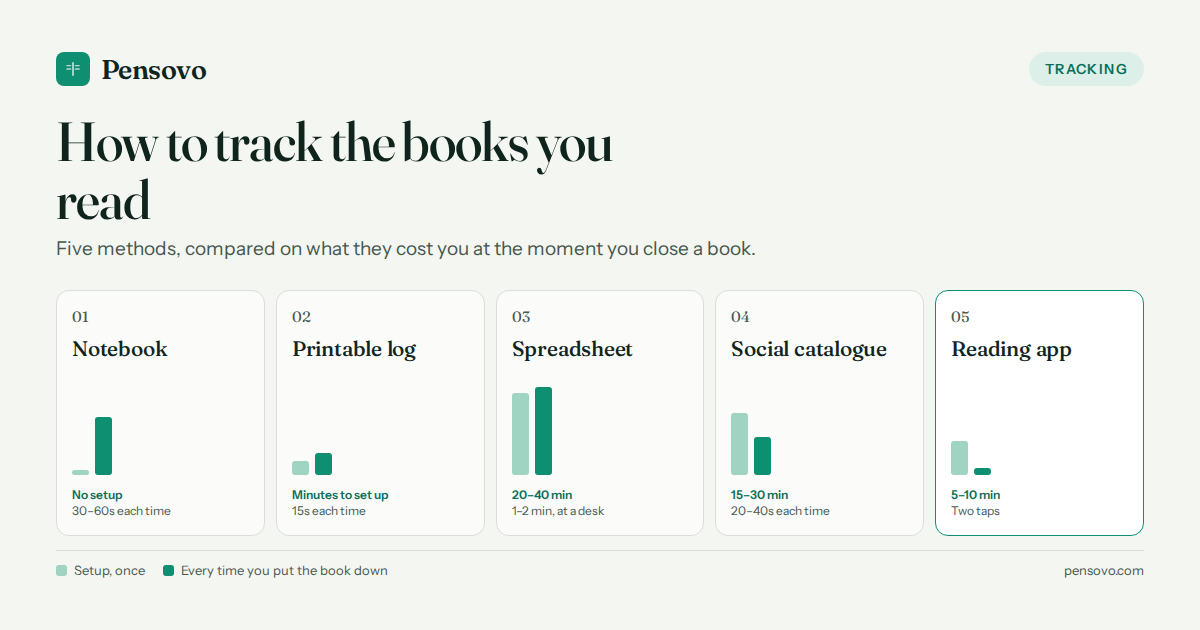
Setup is what it costs to begin. Effort per session is what it costs each time you put a book down. The last column is the one people forget to ask about until a year has passed.
| Method | Setup | Per session | What it gives back | Where it fails |
|---|---|---|---|---|
| Notebook | None | 30–60 seconds, if it is in reach | A pleasant object; no lock-in; nothing to charge | Cannot be searched, sorted or counted. One spilled drink is the whole archive |
| Spreadsheet | 20–40 minutes | 1–2 minutes, at a computer | Sorting, filtering, charts, totals — answers questions nothing else can | Nobody opens a spreadsheet at 11pm. Entries get deferred, then skipped |
| Printable log | Minutes | 15 seconds | Visible on a wall or in the book itself; excellent for children | Fixed rows. Runs out, or shames you with blank ones |
| Social catalogue | 15–30 minutes | 20–40 seconds | Recommendations, reviews, friends, reading challenges | The feed. Reading becomes performance, and the shelf becomes a profile |
| Reading app | 5–10 minutes | 2 taps | Progress, streaks, collections, a searchable history | Another app. Depends on the company staying in business |
1. A notebook
The oldest method and still the one with the highest completion rate among people who genuinely enjoy the object. A cheap notebook, one line per book, date finished on the right.
It fails in exactly one way, but the failure is total: you cannot ask it anything. "How many books did I read last year?" means counting by hand. "What was that novel about the lighthouse?" means flicking through pages. If you never want to ask, a notebook is not a compromise — it is the correct answer.
2. A spreadsheet
The power user's choice, and the one most likely to be abandoned in March. A spreadsheet will tell you your median days-to-finish by genre, which nothing else on this list will. It will also sit unopened on a laptop in another room while you finish a book in bed.
If you go this way, keep it to six columns and put a shortcut to it on your phone's home screen. The constraint is not analysis; it is capture.
3. A printable reading log
Underrated for adults and close to essential for children, who respond to a visible row of filled-in boxes in a way adults pretend they do not. Print it, put it where you read, tick it.
The limitation is arithmetic: a page holds what a page holds. That is fine for a school year and awkward for a decade.
4. A social cataloguing site
Goodreads, StoryGraph, Fable and their relatives combine a tracker with a social network. You get recommendations, reviews from people whose taste you can calibrate against, and a yearly challenge that a great many people find genuinely motivating.
You also get a feed, and a feed changes the thing being measured. Some readers find that shelving a book publicly makes them read more; others find themselves choosing books that look better on a profile than they read in a chair. It is worth knowing which of those two you are before you pick.
5. A dedicated reading app
A tracker without the network: the book, the progress bar, the date, your notes. Logging is two taps on a device already in your hand, which is the lowest per-session cost available, and the history is searchable the way paper never is.
The two honest costs are that it is one more app, and that your history lives with a company. Both are manageable, and the second has a specific test: before you commit years of reading to any tracker, check that it can export your data. A service you cannot leave has stopped competing for you.
How do I track books I have already read?
Badly, and quickly, and then stop.
The instinct is to reconstruct everything — to sit down with a new system and recover a decade. Almost nobody finishes, and the abandoned backfill takes the new habit down with it.
Add the last ten or fifteen books you remember clearly. Mark them finished with an approximate date; "2025" is a perfectly good date. Then start logging properly from today. The value of a reading log is almost entirely in the next year of entries, not the last ten — and a year from now the gap will not be visible.
What about books I did not finish?
Record them. An abandoned book is real evidence about your taste, and unrecorded, it costs you the same evening twice: you will pick it up again in two years and stop at the same page.
Note the page you stopped at and one line on why. "Too slow, was tired" and "dislike the narrator" point at different futures — the first book deserves another attempt, the second does not. Most trackers support a did-not-finish status precisely because most readers need one.
Which method should you choose?
By what you actually want out of it:
- You want to remember what you read — a notebook or an app, whichever is closer to where you read.
- You want to read more — something with a visible daily signal. A streak or a wall chart both work; a spreadsheet does not.
- You want to analyse your reading — a spreadsheet, or an app that exports to one.
- You want recommendations — a social catalogue. This is the one thing a private tracker genuinely cannot give you.
- You are tracking a child's reading — a printable log, on the fridge.
And if you cannot decide, pick the one you can update in ten seconds tonight. A mediocre system you use beats an excellent one you don't, and this is one of the few places where that cliché is the literal mechanism.
Common questions
What is the easiest way to track the books you read?
A dedicated reading app is the lowest-effort option once it is set up, because logging takes one or two taps on a phone you are already holding. A notebook is the lowest-effort option to start, because there is nothing to set up at all. Which is "easiest" depends on whether your friction is at the beginning or in the daily habit — and for most people who have abandoned a tracker before, it is the daily habit.
How do I track books I have already read?
Do not try to reconstruct your whole history. Add the last ten to fifteen books you remember clearly, mark them finished with an approximate year, and start logging properly from today. A partial backfill you finish in twenty minutes is worth more than a complete one you abandon halfway.
Should I track books I did not finish?
Yes. An abandoned book tells you something true about your taste, and if you do not write it down you will start it again in two years and stop at the same page. Note the page and one line on why you stopped; that line is usually enough to tell later whether it was the book or the week.
Is a spreadsheet good enough?
For analysis, it is better than everything else here. For capture, it is the worst of the five. Opening a spreadsheet on a phone at eleven at night is exactly enough friction to skip an entry, and skipped entries are what kill a reading log. If you use one, put a shortcut on your phone's home screen and keep it to six columns.
Do reading streaks actually help?
For some readers, clearly. A visible streak turns "I should read more" into a concrete daily cue, which is the same mechanism behind exercise and language streaks. The risk is that a broken streak becomes a reason to quit altogether, so the useful kind treats a missed day as a missed day rather than a verdict on you.
Can I move my reading history between apps?
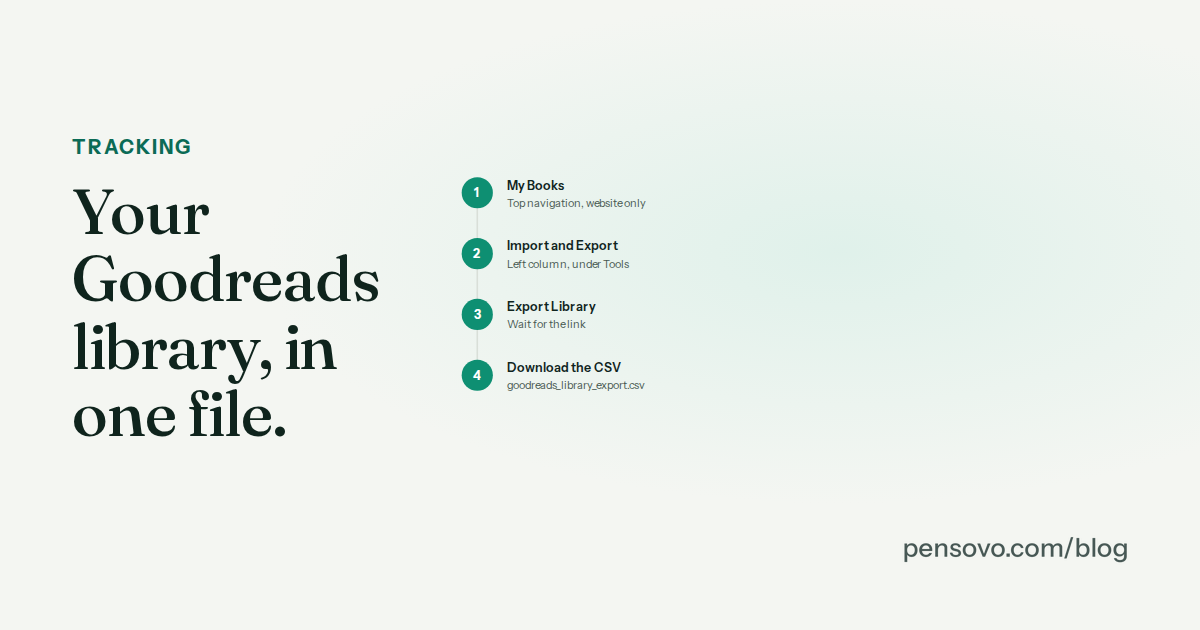
Sometimes, and you should check before you commit. Goodreads offers a CSV export of your library and several apps import it. Ask of any tracker: can I get my data out in a standard format? If the answer is no, you are not choosing a tool, you are choosing a landlord.
How many books should I be reading?
There is no number that makes you a reader, and the surveys people quote at each other measure wildly different things. A more useful question is whether you read on most days, because consistency is what a tracker can actually show you — and it is the variable that moves.