Amol B
Work it out from your goal
Put in the books you want to read this year, roughly how long they are, and how many days a week you will honestly read. The calculator gives you the nightly page count, how long that takes at your pace, and how many days each book takes.
Pages-a-day calculator
Two things people notice. First, the number is smaller than they feared: two books a month is about twenty pages a night. Second, the days-a-week setting matters more than the pace — dropping from seven days to five raises the nightly requirement by 40%, which is why a target built on seven days fails in February.
How long does it take to read 25 pages?
About half an hour for most adults reading an ordinary novel or trade non-fiction. The best available estimate of adult silent reading speed is 238 words a minute (Brysbaert's 2019 meta-analysis of 190 studies), and a typical paperback page carries 250–300 words, so a page a minute is a fair rule of thumb — call it 45–60 pages an hour for light books and 25–35 for dense ones.
| Pages a day | Minutes a day (typical pace) | Books a year (300 pp, 6 days/week) | What it feels like |
|---|---|---|---|
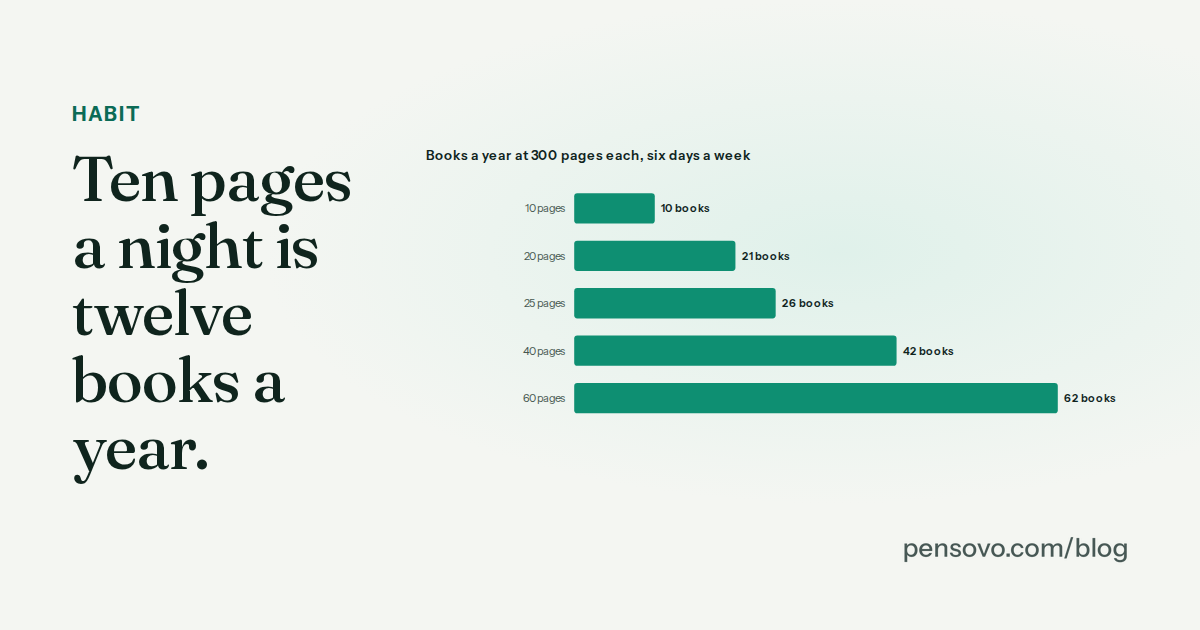
| 10 | 12–15 | about 10 | A floor you can hold in a hotel bed after a long day |
| 20 | 25–30 | about 21 | The habit most regular readers actually keep |
| 25 | 30–35 | about 26 | Farnam Street's famous '25 pages a day' — a book every twelve days |
| 40 | 50–60 | about 42 | An hour; needs a protected slot |
| 60 | 75–90 | about 62 | Serious commitment or light books |
Should you count pages or minutes?
Pages, if you mostly read print and want a number you can log without a stopwatch. Minutes, if you mix audiobooks and ebooks with print, or if you read dense books where twenty pages is a real evening. Whichever you choose, the habit is the same: a small daily minimum, logged the same night. Many trackers let you log either; a reading session with a timer counts the day without a page number.
Why ten pages is the right floor
A reading habit fails on the worst day, not the average one. If your floor is forty pages, the night you have twelve minutes you skip it, and two skips become a lapsed habit. If your floor is ten, that night still counts, the streak survives, and tomorrow you read forty again. Over a year the floor alone is about 3,650 pages — twelve books from a habit that was never allowed to break.
Does reading faster help?
Less than reading more often. Genuine speed-reading techniques mostly trade comprehension for pages, and the meta-analysis above found no evidence that most adults can double their pace without losing understanding. Three anchors of ten minutes each — coffee, commute, bed — is thirty minutes a day and roughly a book a week for an average paperback, with no change in speed at all.
Common questions
Is 20 pages a day enough?
Yes. Twenty pages a day, six days a week, is about twenty-one 300-page books a year — more than most adults read. It takes most people 25–30 minutes.
How many pages is 30 minutes of reading?
Roughly 25–30 pages of an ordinary paperback for a typical adult, based on about 238 words a minute and 250–300 words a page. Dense non-fiction can halve that.
How many pages a day to read 52 books a year?
About 50 pages a day, six days a week, at 300 pages a book — roughly an hour. Reading seven days a week brings it to 43.
Is 50 pages an hour fast?
It is slightly above the typical adult pace for light books and well above it for dense ones. Most adults read 40–50 pages of a novel an hour.
Should I count audiobook time as pages?
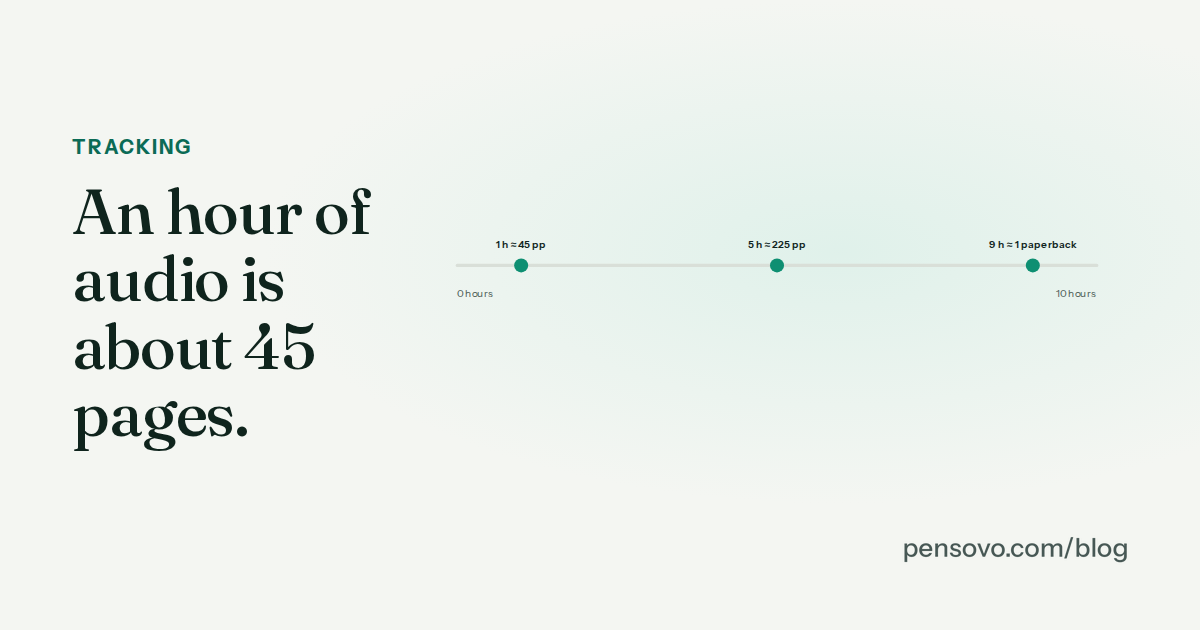
Log minutes instead, or convert at roughly one page per minute of narration. The point is a daily minimum you can hit, not a precise page count.
What if I miss a day?
Read tomorrow, even if it is only the ten-page floor. One missed day is life; two in a row is the start of a lapse.