Amol B
Why are audiobooks awkward to track?
Because most trackers were built around a page number, and an audiobook does not have one. Readers respond in three ways: they do not log audiobooks at all (and under-count their year), they guess a page from the percent bar (and log nonsense), or they keep audiobooks in a separate list that never meets the rest of their reading. None of these is good. The better answer is to log the unit the book actually has — time — and convert only when a goal demands it.
Should you log minutes, percent, or pages?
| Unit | Where you find it | Good for | Weak for |
|---|---|---|---|
| Minutes listened | The player's session or the difference in time remaining | Daily minimums, streaks, honest totals | Comparing with print books |
| Percent complete | The progress bar | Knowing where you are; rereads | Daily goals (10% of a 20-hour book is two hours) |
| Converted pages | Minutes × about 1 page/minute, or percent × the print edition's page count | One number across formats; pages-per-day goals | Precision; narration speed varies |
If your tracker only takes pages, use percent of the print edition's page count: 40% through a 350-page book is page 140, whatever the narrator's pace. It is a fiction, but a consistent one.
How do you convert audiobook hours to pages?
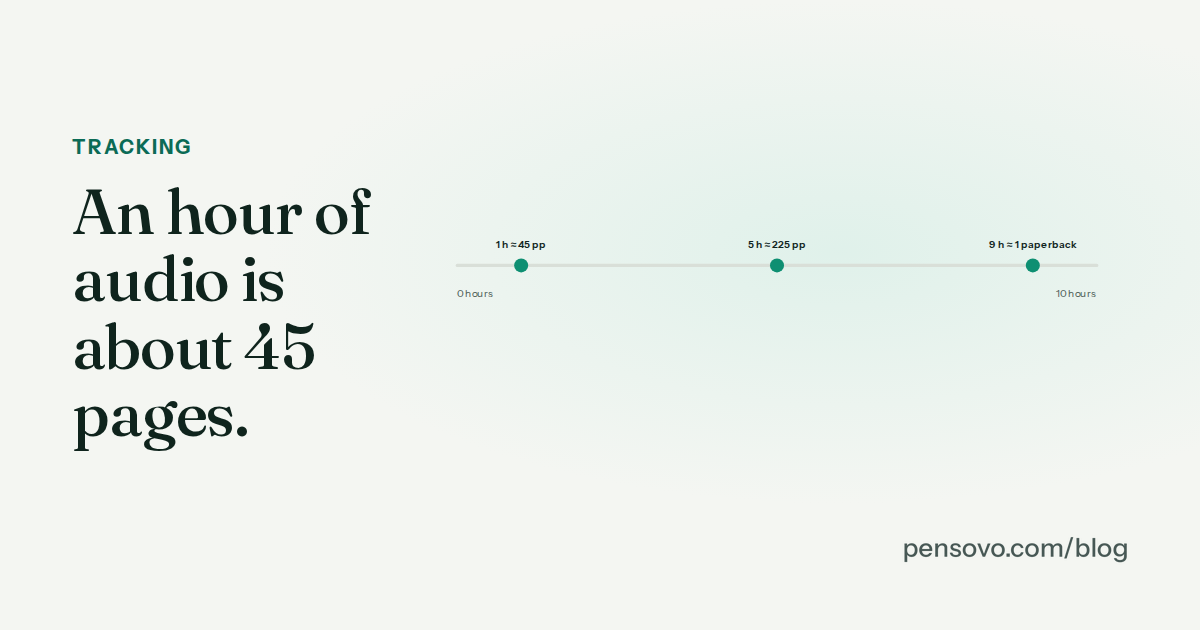
Narrators read at about 150–160 words a minute; a printed page holds about 250–300 words. So a minute of narration is roughly half to two-thirds of a page at natural speed — but most listeners play at 1.2x to 1.5x, which brings it to about a page a minute. Hence the rule of thumb: one hour of audio is about 45–60 pages, and a nine-to-ten-hour audiobook is a 300-page book.
Do audiobooks count toward a reading streak or goal?
Yes, and the people strictest about this tend to read least. A streak measures showing up with a book; an audiobook on a walk is showing up. For a books-per-year goal, count the book when the narration ends. For a pages-per-day goal, convert as above or, better, switch the goal to minutes a day so that print and audio are the same currency.
How do you keep audio and print in one library?
Three small habits. Record the format on each book (audio, ebook, print, or a mix — plenty of books are started on paper and finished on a walk). Log the day you listen, not the day you remember. And when a book exists in both formats, track one copy and note the other; two entries for the same book double-count your year.
Which trackers handle audiobooks well?
StoryGraph lets you log by percent or minutes and records the format. Bookly's timer works for listening sessions as well as reading ones. Goodreads only takes pages or percent, so you convert. Pensovo counts a Reading Mode session as a reading day without a page number — start the timer when you press play — and lets you log a page or percent when you want a position; a minutes-first log is on the roadmap.
Common questions
Do audiobooks count as reading?
For the purposes of a habit or a yearly goal, yes. Comprehension studies find similar retention for narrative books heard and read; the difference shows up mainly with dense material you would re-read. Count the book.
How many pages is an hour of audiobook?
About 45–60 pages at the playback speed most people use (1.2x–1.5x); about 35 at 1.0x. A page a minute is a good enough rule.
How do I log an audiobook on Goodreads?
Goodreads only takes a page or a percent. Enter the percent from your player, or convert percent to a page of the print edition.
Should I keep audiobooks on a separate shelf?
Keep them in the same library and record the format on each book. A separate shelf is how audiobooks fall out of your yearly count.
Does listening at 2x still count?
Yes. Speed changes the minutes, not the book. If you track minutes, your totals will simply be smaller; if you track pages, convert at your speed.
Can I track an audiobook I started in print?
Yes — one entry, format noted as mixed. Log the page when you read and the minutes or percent when you listen; the finish date is the finish date.