Amol B
How big is the Indian book market?
About US$5.13 billion in 2025, on IMARC's estimate, growing to roughly $7.3 billion by 2034 — about 4% a year. Educational publishing is the largest slice (around 35%), which matters when reading the trade numbers: a great deal of India's "reading" is exam preparation. Print holds about 73% of the market, ebooks 16%, audiobooks 11% and rising fastest at around 12% a year.
| Measure | Figure | Source |
|---|---|---|
| Book market, 2025 | US$5.13bn | IMARC (commercial estimate) |
| Forecast growth to 2034 | ~4% a year, to US$7.3bn | IMARC |
| Print share | ~73% | IMARC |
| Ebook / audiobook share | ~16% / ~11% | IMARC |
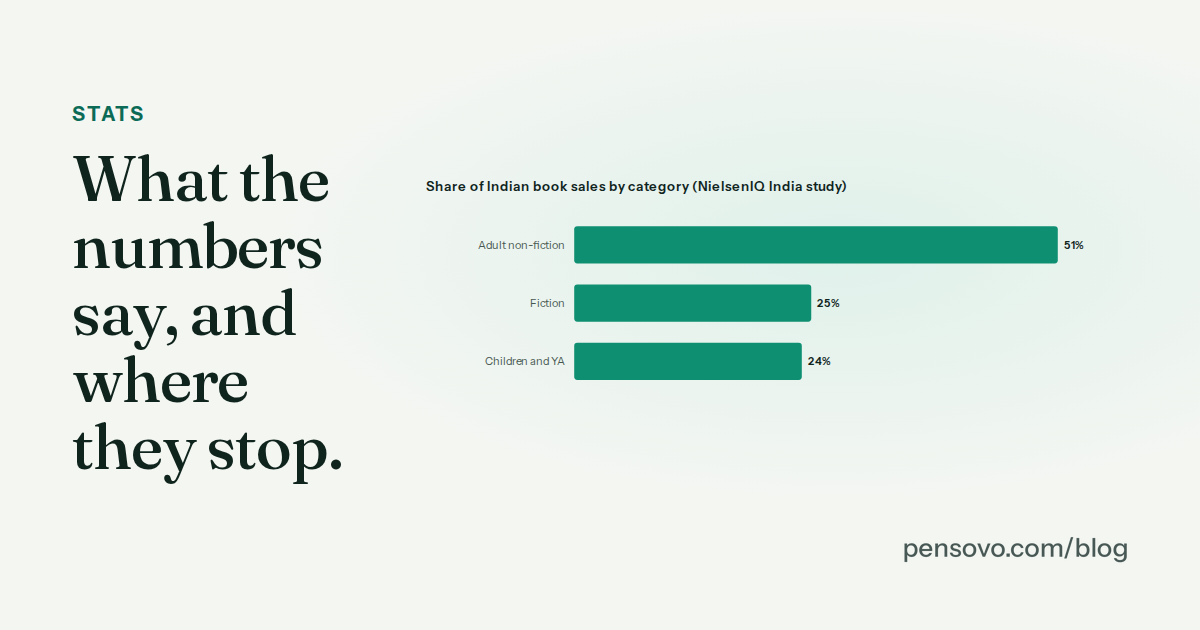
| Adult non-fiction share of trade sales | 51% | NielsenIQ India Books & Consumers |
| Fiction / children and YA | 25% / 24% | NielsenIQ |
| Paying audio-content subscribers, one platform | 10 million (Kuku FM) | TechCrunch, Oct 2025 |
| Internet users | ~958 million | IMARC, citing government data |
What do Indians read?
Non-fiction, first. Self-improvement, business, biography and exam-adjacent titles make up about half of trade sales, a far higher share than in the US or UK, where fiction leads. Fiction is a quarter, with a fast-growing romance and "romantasy" readership among Gen Z that mirrors the West. Children's and young-adult books are the remaining quarter and are the segment publishers describe as most resilient. Regional-language publishing — Hindi, Bengali, Tamil, Marathi, Malayalam among others — is large, under-measured and mostly print.
Who is reading, and how?
The honest answer is that nobody has counted properly. The NielsenIQ consumer study is online-only, which skews it toward urban, English-speaking, younger readers. The signals within that skew are consistent: reading rises with education and income, English-language readers over-index on non-fiction, and the 18–30 cohort is the most active in buying and in discussing books online. Anecdotal but real: silent reading clubs — Cubbon Reads in Bengaluru, Bandra Reads in Mumbai, Delhi Reads and dozens of copies — have grown from one park in 2023 to a national weekend habit, and they are almost entirely young.
The audio story
Audio is where India's reading numbers are moving fastest. Kuku FM reported 10 million paying subscribers in October 2025, up from 2 million two years earlier, with 80% outside the top metros and a most-popular plan of ₹499 a quarter. Pocket FM and Audible India compete for the same commute. Much of the content is serialised fiction rather than books in the traditional sense, but the behaviour — paying to have stories read to you, daily, on a phone — is the reading habit in a new format, and it is the clearest evidence of what Indian readers will pay for.
How does India compare?
In the US, 75% of adults read at least part of a book in the past year and 14% read twenty or more (Pew, 2026); the median American who reads finishes about two books a year (YouGov, 2025). In the UK, 53% call themselves regular readers (Reading Agency, 2025). India has no comparable national figure. The World Population Review's often-quoted "Indians read 10.7 hours a week, most in the world" traces to a 2005 NOP World survey of urban internet users and should not be repeated as current fact.
What would better data look like?
A household survey, not an online panel, in at least the ten major languages, asking about books read for pleasure in the past year and time spent reading per day. Until one exists, treat any single India-wide reading percentage with suspicion, and treat the market and category data above as the reliable core.
Common questions
How many books does the average Indian read a year?
No reliable national figure exists. The online surveys that exist skew urban and English-speaking. Treat any single number you see with suspicion until a household survey is done.
Is reading declining in India?
Trade publishers report flat-to-growing sales and the market is forecast to grow about 4% a year. Time spent on books competes with phones, as everywhere, but audio and reading clubs are growing.
What genre sells most in India?
Adult non-fiction, at about half of trade sales — self-improvement, business, biography and exam-adjacent titles. Fiction is about a quarter.
Do Indians read more in English or in regional languages?
Regional-language publishing is large and mostly print, but it is badly measured. English dominates the online data because the surveys are online.
Why are audiobooks growing so fast in India?
Cheap data, long commutes, phones as the primary device, and pricing set for the market — ₹499 a quarter at the largest platform. Serialised audio fiction leads the growth.
Where does the 'Indians read 10.7 hours a week' statistic come from?
A 2005 NOP World survey of urban internet users in 30 countries. It is two decades old and was never nationally representative.