Amol B
Why do we forget what we read?
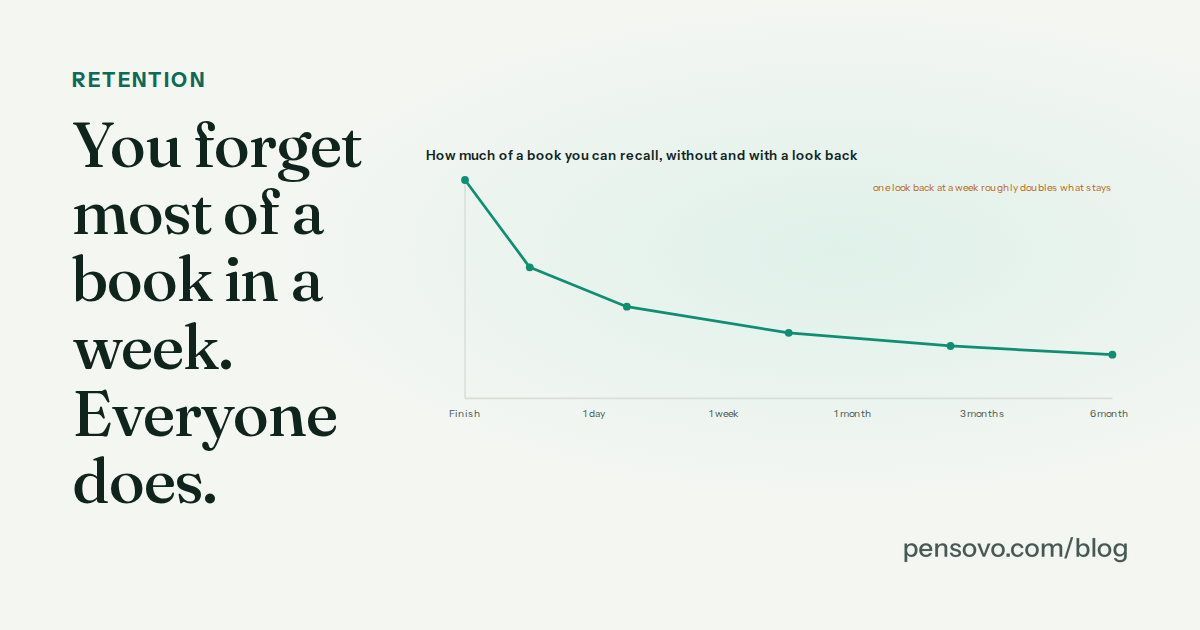
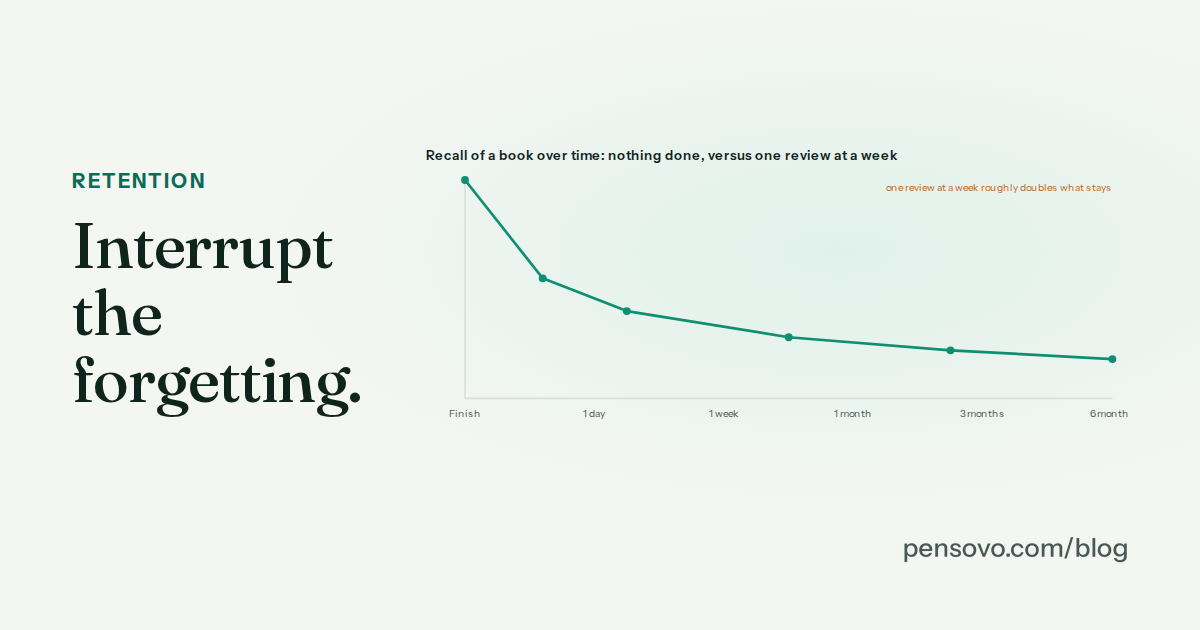
Because memory decays along a curve that is steep in the first days and flat afterwards — Ebbinghaus mapped it in 1885 and a 2015 replication (Murre and Dros) found the same shape. Reading adds a specific problem: most of a book is read once, forwards, with nothing asking you to recall any of it, so nothing interrupts the decay. What survives the first month tends to survive for years; the work is getting more into that flat part.
What actually works
1. Read with a question
Before you start, write one question you want the book to answer — even "what is this actually about?" Attention needs a task; a question gives it one, and gives the finish-line note something to answer. For non-fiction this is the single biggest change most readers can make.
2. Capture at the page
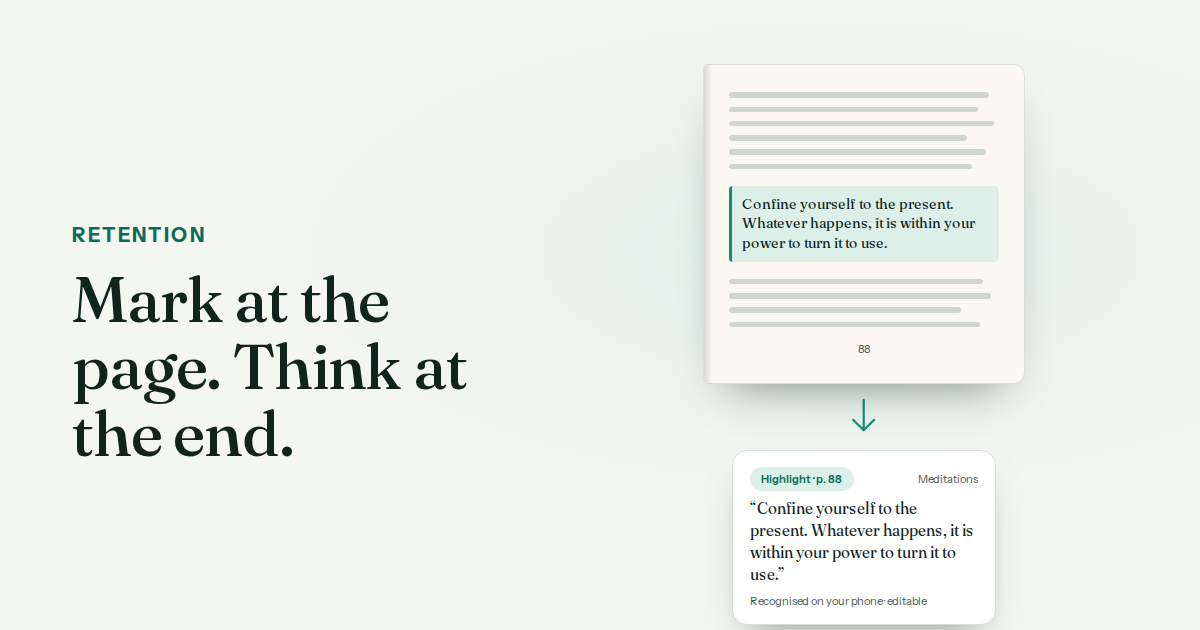
The passage that stops you should be kept at the moment it stops you: underline it, tab it, or photograph the page so the text is saved with its page number. Waiting until the end of the chapter loses most of them. A book with thirty captured passages is a book you can return to; a book with three hundred is a highlighter reel.
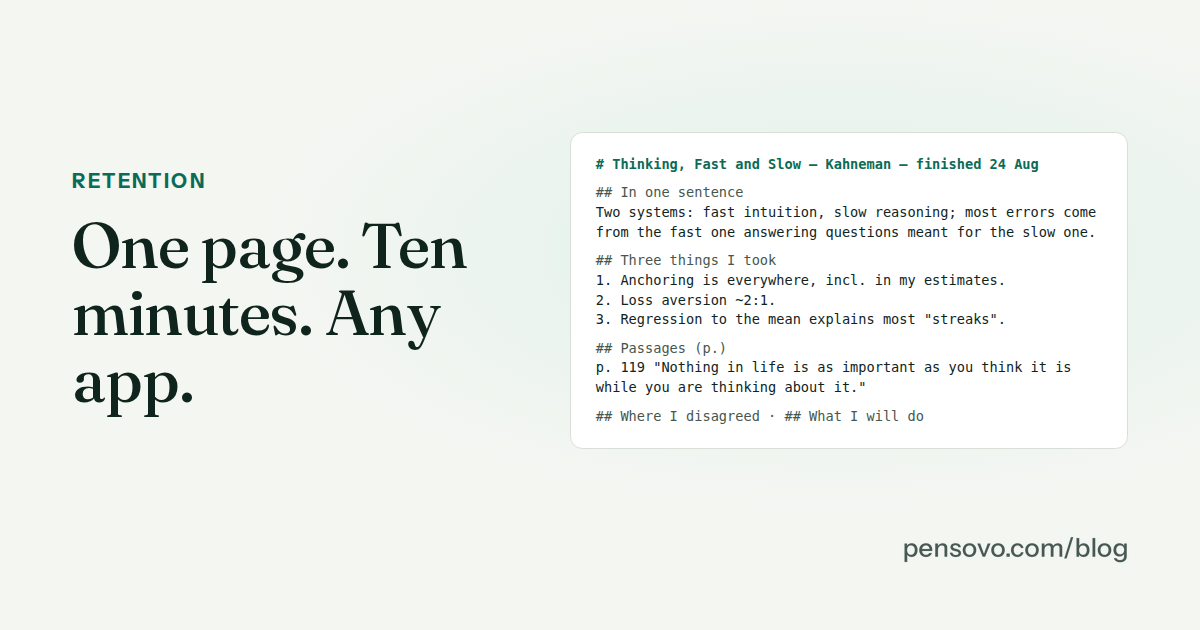
3. One line when you finish
What it was about, or what you took from it. Writing forces retrieval, and retrieval is the strongest memory act there is. Roediger and Karpicke (2006) had students either re-read a passage or try to recall it; a week later the recall group remembered far more, even though re-reading had felt more effective at the time.
4. Look back once, about a week later
Open your notes on the book and read them for two minutes. That single review is the cheapest known way to lift the whole forgetting curve. If you do nothing else on this page, do this.
5. Tell someone
Explaining a book to a friend is retrieval with stakes, and it exposes the parts you did not actually understand. Book clubs work for memory as much as for company.
What does not work
| Method | Why it feels like remembering | Why it isn't |
|---|---|---|
| Highlighting without returning | The book looks worked-on | Marking is not retrieval; unrevisited highlights are decoration |
| Re-reading the whole book | Everything is familiar | Familiarity is not recall; Roediger's re-readers remembered less |
| Reading faster | More books finished | Comprehension falls past ~400 wpm; there is less to remember |
| Summaries instead of the book | You know the outline | Nothing for memory to attach to; the texture is what sticks |
| Copying out every quote | It is effortful | Effort without selection; choose five, not fifty |
A routine that fits in ten minutes a book
Does format matter — paper, screen, audio?
A little. Several studies find slightly better recall of where things happened in a text when it was read on paper, which may be about the physical map of a book; for narrative books, listening and reading produce similar comprehension (Rogowsky and colleagues, 2016). All of these effects are smaller than tiredness and much smaller than writing one line. Read in the format you will actually read; keep the notes in one place.
What about spaced repetition and flashcards?
They work, and for most readers they are more system than the reading deserves. A middle path: keep the passages you captured somewhere that resurfaces them — a monthly two-minute reread of ten random highlights does most of what a flashcard deck does, with none of the maintenance. For a book you are studying rather than reading, flashcards earn their keep.
Common questions
Why do I forget books so quickly?
Because memory decays steeply in the first days unless something makes you retrieve it. It is the normal shape of forgetting, not a flaw; small acts of recall fix most of it.
What is the best way to retain what you read?
Recall, not re-reading: one line when you finish, a two-minute look back at your notes a week later, and explaining the book to someone.
Does highlighting help you remember?
Only if you return to the highlights. Marking passages without revisiting them feels like remembering and is not.
Should I take notes while reading or after?
Capture passages during, with page numbers; write the summary and takeaways within a day of finishing, when you know what mattered.
Is it better to read on paper to remember?
Slightly, for where things were in the text. The effect is small next to tiredness and next to writing a line about the book.
How many books should I read at once if I want to remember them?
As many as you can give a finish-line note and a look back. For most people that is one or two; a third book is the one nobody remembers.