Amol B
Is it normal to forget a book right after finishing it?
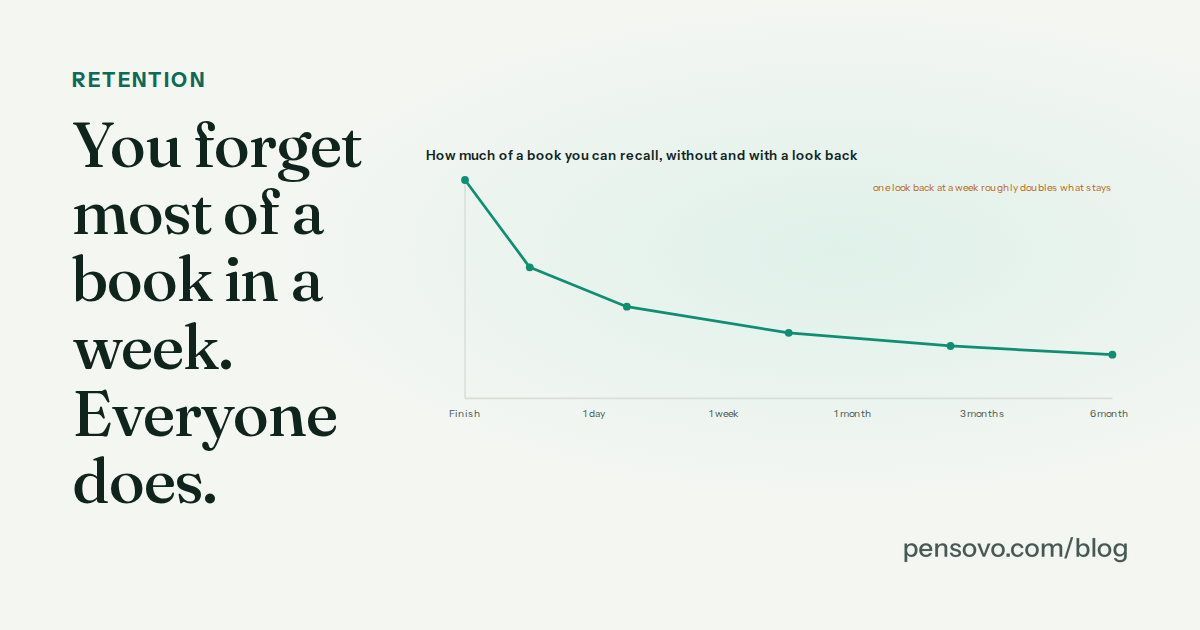
Yes, and it has been measured for 140 years. Hermann Ebbinghaus found in 1885 that memory for new material drops steeply within a day and then flattens; a 2015 replication (Murre and Dros) found the same shape. For a novel, most readers can recount the plot the day they finish, a rough outline a week later, and a feeling plus one or two scenes after a few months. For non-fiction it is worse, because the ideas were never attached to a story in the first place.
The reassurance is that the flat part of the curve is real: what survives the first month tends to survive for years. The trick is to get more into that flat part, and the way to do it is to interrupt the steep part.
What makes it worse?
- Reading only forwards. Never pausing to say what just happened, never looking back a chapter.
- Reading to finish. A yearly books goal rewards closing the book, not keeping it.
- No trace. Nothing written, nothing marked, no record of even having read it. Six months later the title looks familiar and that is all.
- Tiredness and phones. Reading in bed after an hour of scrolling produces pages your eyes crossed and your mind did not.
- Passive highlighting. Marking passages without ever revisiting them feels like remembering and is not.
What actually fixes it?
1. One line when you finish
Not a review. One sentence: what the book was about, or what you took from it, or the scene you will still see in a year. Writing forces retrieval, and retrieval is the strongest memory act there is — stronger than re-reading, as Roediger and Karpicke showed in 2006 with students who recalled far more a week later when they had been tested rather than allowed to re-study.
2. Keep the passages where you can find them
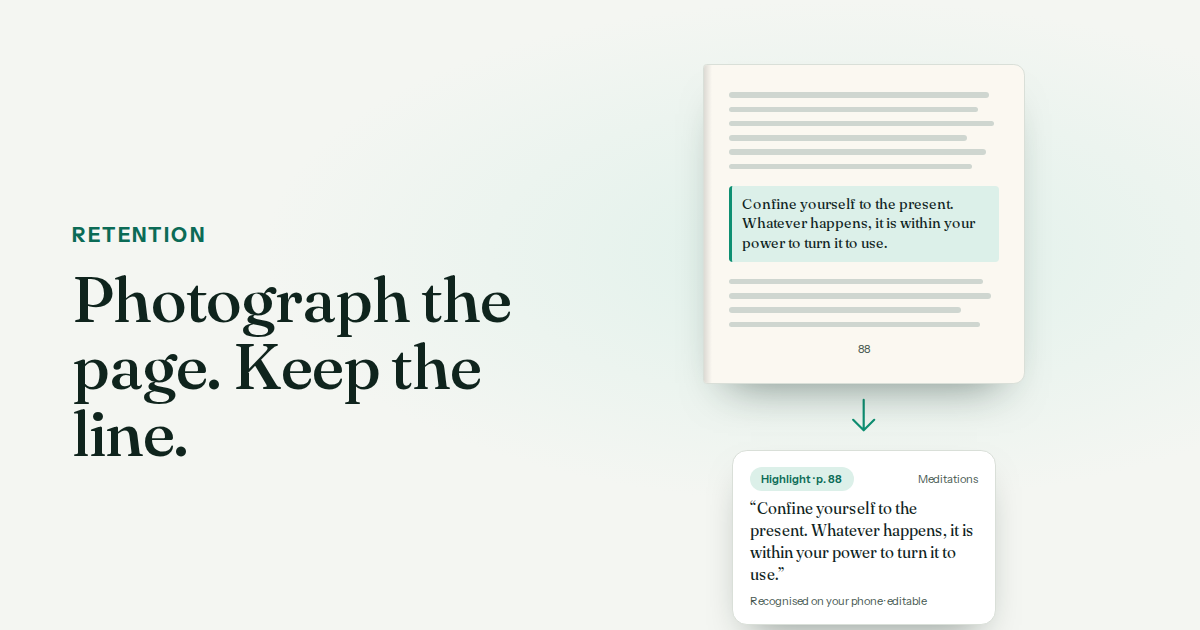
Underlining in a book you will never reopen is a gesture. A highlight that lives somewhere searchable, attached to the book and the page, is a memory you can reach. For paper books the friction used to be typing; now you photograph the page and the passage becomes text.
3. Look back once, about a week later
Open your notes on the book, or just the highlights, and read them for two minutes. That single review is the cheapest known way to lift the whole curve. If you do nothing else on this page, do this.
4. Tell someone
Explaining a book to a friend is retrieval with stakes. Book clubs work for memory as much as for company.
Does it matter whether I read on paper or a screen?
A little, for some kinds of reading. Several studies find slightly better recall of where things happened in a text when it was read on paper, which may be about the physical map of a book. For most readers the effect is smaller than the effect of being tired, and much smaller than the effect of writing one line. Read in whichever format you will actually read; keep the notes in one place regardless.
What about speed reading and summaries?
Speed reading trades comprehension for pages; you will remember less, not more. A good summary read after the book is a review and helps; a summary read instead of the book gives you the outline and none of the texture that makes memory stick. Use summaries to decide what to read and to look back on what you read, not as a replacement.
Common questions
Why do I forget books so quickly?
Because memory for new material decays steeply in the first days unless something interrupts the decay — the forgetting curve. It is normal, and small acts of recall fix most of it.
How can I retain more of what I read?
Write one line when you finish, keep the passages that struck you somewhere you can find them, and look back once about a week later. Recall beats re-reading.
Is highlighting a good way to remember?
Only if you revisit the highlights. Marking passages without returning to them feels like remembering and is not; a two-minute review a week later is what makes them stick.
Do I remember more from paper than from a screen?
Slightly, in some studies, especially for where things happened in a text. The effect is small next to tiredness and next to writing a line about the book.
Should I re-read books?
Re-reading a book you loved is a pleasure and a review. Re-reading to memorise is inefficient; trying to recall first, then checking, works better.
Does reading a summary help me remember a book?
After the book, yes — it is a structured look back. Instead of the book, no; you get the outline without anything for memory to attach to.